
Parenting Scripts: Supportive or Stifling?
It depends on how and why they're being used.

A few things may be getting lost in translation when it comes to parenting scripts. If you haven’t heard of parenting scripts, good for you! You’re probably not missing out on much.
If you have heard of parenting scripts and you find them to be supportive, well, good for you too. Seriously. Anything, anything that makes parenting feel easier is a win.
But there’s something to consider when it comes to parenting scripts, which is that they may be both supportive and restrictive, depending on how and why they are used. After all, it’s not uncommon for an immediate solution to become part of a later problem.
Here’s an example for you.
Years ago I broke my pinky toe. I was put in a small, soft, non-restrictive shoe. It had thick foam at the bottom and velcro straps on the top. After a week or two I went back to my doctor for a follow up only to have her tell me my toe was healing horribly and that if I didn’t stay off of it my next stop would be surgery where she would install some pins and screws.
“Well, a kid accidentally dropped a lunchbox on it and this little boot doesn’t really protect me very well.” I told her.
I also told her staying off of it was not an option for me. At that point I had a three year old and a four month old and taking weeks off of work for a pinky toe just didn’t sit right with me.
“One of your kids?” she asked.
“No, it happened at work.” I responded.
“What do you do for a living?” She asked.
“I run a preschool.”
She immediately got me a bigger, sturdier, more restrictive boot.
My toe started healing and I didn’t end up needing surgery. But, when it was time for me to come out of the big boot my doctor suggested I go to physical therapy which I scoffed at. Physical therapy for a pinky toe?! No, actually, the physical therapy would be for my Achilles tendon, which had weakened significantly because I was in the restrictive boot for so long.
In this case, the solution to my original problem, necessary for a time, had exposed me to a new problem. The restrictive measures needed to heal a broken bone created weakness in another, previously unimpacted, area.
So now, let’s shift back to scripts
Scripts can be a nice temporary, supportive measure. They are, in teacher talk, a great scaffolding tool. Scaffolding is a method where a teacher offers significant support initially, then gradually and incrementally withdraws that support, making room for the student to gain incrementally more competence and independence.
The issue with a lot of what I am seeing in regards to scripts is that they are largely doled out by parenting experts who aren’t necessarily familiar with what level of scaffolding their parent population/audience is in need of. Many are offering potential scripts for a myriad of situations. Likely these are generated by parents who come to them with the exact concerns the expert’s sample scripts may address. Why just answer one parent’s question when you could make a reel and disseminate helpful information to thousands of people at a time? It seems logical and it can be helpful, but it can also leave some parents relying on support that is no longer serving them.
Worse still, it can cause some parents to doubt themselves when their own word choices and manner of speaking toward their children differs from what an expert is suggesting. Finally, it can send the inadvertent message that every single word a parent utters to their child carries with it alarmingly high stakes.
I am not advocating for doing away with parenting scripts entirely, but what I am encouraging is for parents to think critically about whether the support they avail themselves to is truly helpful or if it has started to feel prescriptive and constrictive. Whether it is cultivating ease or sowing doubt. Whether it is making them feel more competent or less so. Whether the support they utilize is actually creating weakness in another, previously unimpacted area— their own authenticity within the parent-child relationship.
This is essentially the point I am trying to make in my latest article from Business Insider. We want to avail ourselves to support when it comes to how to navigate certain situations, but we don’t want to do it at the expense of showing up authentically for ourselves or our child.
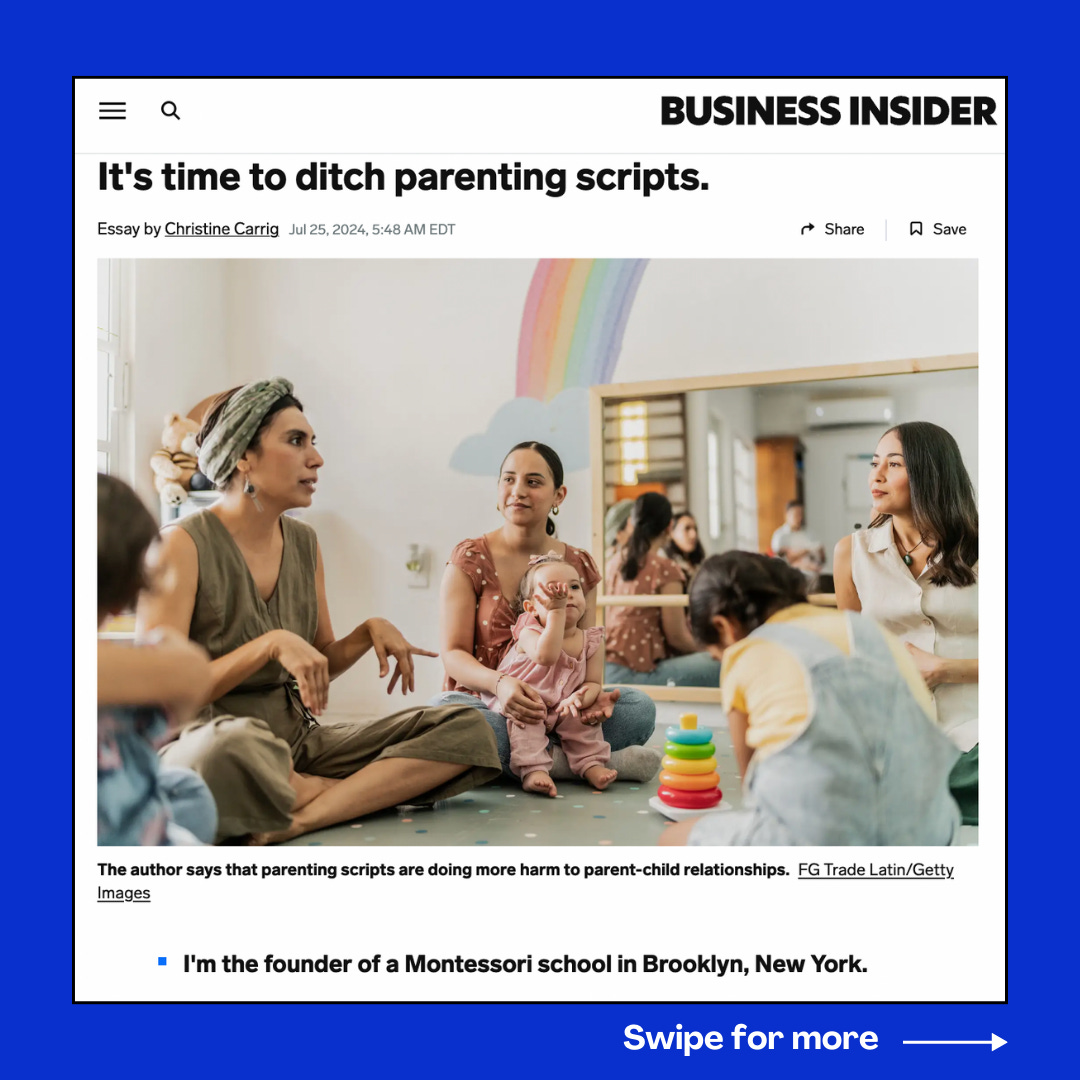
Here’s an excerpt from that article:
“Congruence, in an interpersonal sense, simply means that a person's inner experience matches their outer expression. If a parent can use scripts as a loose guide, adapting words to their own style and manner of speaking, then more power to them. If, however, a parent is using scripts in a way that causes them to feel as if they need to flip into performance mode or put on a "mom mask" every time they're around their kid, then it's time to ditch the script.
“Implementing a script with that level of adherence is more likely to create repression and burnout in the parent and confusion and frustration in the child. To put it simply, words only work if we mean them, even expertly vetted words.
“The parent-child relationship is one of the most intimate relationships humans experience. Yes, we want to be thoughtful in our communication, but there's no need to sterilize it with scripts. Even when words are optimal, sacrificing authenticity isn't a good trade-off.
“Children need their parents to be congruent in their interactions, even if they might misspeak from time to time. And parents can trust that, at the end of the day, their hearts are in the right place — so much so that they may even want to speak from it.”
On a slightly different but related note, it might be a good time to remember that the less we say the more our kids hear. In Montessori we try to implement, “economy of language” with children, because they are quick to tune out too many words, no matter how good they are;). A Montessori perspective on the whole script thing would suggest that instead of curating each word, that we simply aim to relay our message with as few words as possible. So with that, it seems like it’s a good time to take my own advice and wrap this post up.
I’ll close with this–language is important, but especially with children, our quality of presence speaks much louder volumes. Let this idea guide you as you discern what feels supportive and what feels stifling when it comes to scripts.
As always, I’m cheering you on,
Christine
PS
If you found this helpful please give it a like or a share.